
Foreword
The recently revised British Energy Security Strategy, looking to help secure UK power needs into the future, has generated considerable industry speculation and commentary. The strategy has a heavy bias, focusing on the big-ticket items with the potential to increase the generation of power. This is expected, since intuitively we need to generate more power to improve security of supply. What is lacking however, is substance on the engineering nitty-gritty about how the extra electricity generated will be utilised, or whether it can even be utilised at all without the necessary technology to store it when demand doesn’t match supply.
As experts in the energy projects space, we have conducted an evaluation on whether the extra proposed generation will make as much as difference as it is claimed and provide our view on what is needed to make reaching net zero by 2050 a reality.
Phil Thompson, CEO of Balance Power
Are we going to generate enough net-zero power?
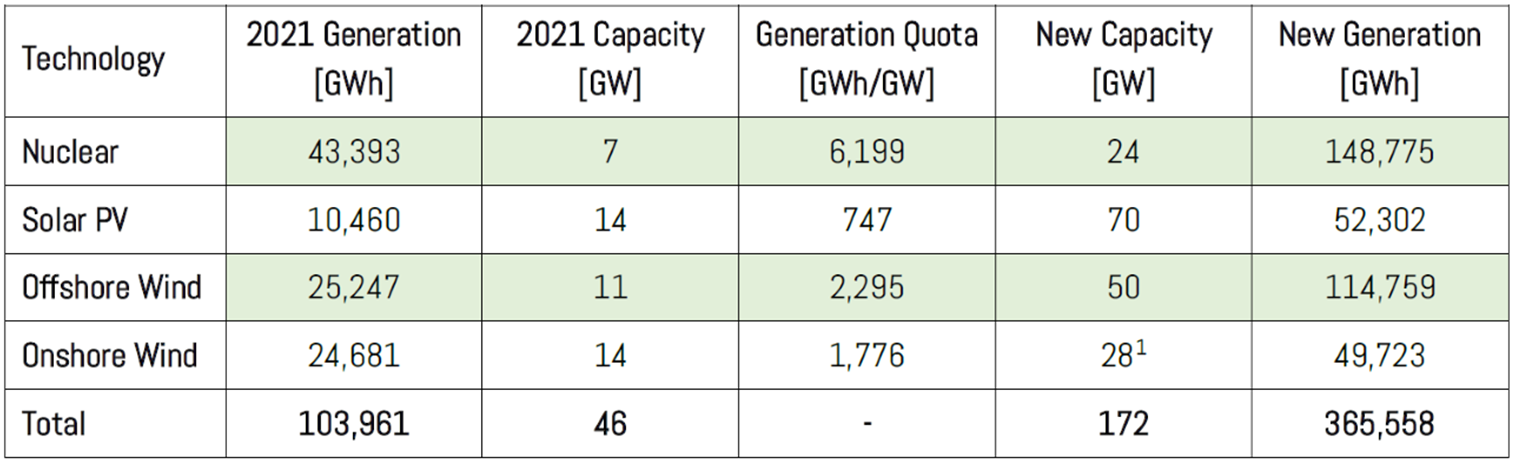
The government’s inclusion of increased nuclear, solar PV and wind capacity in the Energy Security Strategy is a welcome start to realising the goal of operating a net-zero electricity grid by 2035. It has been projected that generation capacity will be over 365TWh per year (demonstrated in Exhibit 1 below), which compares favourably with the UK’s 2021 electricity demand of 260TWh, however, the strategy was vague about projected demand and how generation and demand matches up.
The 365TWh generation figure has been calculated based on the 2021 generation outputs of nuclear, solar PV and both offshore and onshore wind and pro-rated upwards to reflect the proposed capacities in the Energy Security Strategy.
Exhibit 1: Full disclosure of the figures Balance Power has used for generation and capacity analysis
2021 is taken as the reference point for demand, but shouldn’t we do analysis based on future demand?
The simple answer here is, yes. At the time of Balance Power’s analysis, the latest data that was available covers the calendar year 2021 and it is correct to question this when trying to place an estimate on the amount of energy storage that we need in the future. We can calculate that future demand will increase over time based on the expected increased electrification of both transport and heating, and this should be considered if we are to make estimates of proposed electricity storage requirements. Energy demand can be impacted by a number of things, so we have included the impact of this within the sensitivity analyses shown in Exhibit 4 and Exhibit 5.
In addition to this, we are also looking at the sensitivity of the storage needed based on percentages of the targeted capacity being successfully delivered, since there may be obstacles that prevent all the targeted capacity being built. This will be covered in more detail in Exhibit 4 and Exhibit 5.
Surely creating a net-zero grid can’t be as simple as building new generation capacity?
As demonstrated in the previous section, our new analysis of 2021 UK energy capacity and demand data shows that the UK is on track to generate enough net-zero compatible electricity to meet its growing demand. Unfortunately, simply building more generation capacity by itself will not be enough and building more doesn’t solve the problem on its own. Although this is a step in the right direction, further investigation indicates that there is a recurring misalignment of generation and demand that leaves the nation vulnerable to both power shortages (in times of high demand and low generation) and forces curtailment of generated energy (in times of low demand and high generation).
Exhibit 2 demonstrates the hypothetical, but likely misalignment between demand and generation, based on the 2021 UK grid demand, and if the only power generation sources available are nuclear, wind and solar PV. The green “Mean Generation” line on the graph is determined as the 2021 nuclear and renewables UK generation values. These have been pro-rated upwards to match the Government’s proposed installed capacities in the new Energy Security Strategy.
Exhibit 2: The hypothetical misalignment between demand and generation
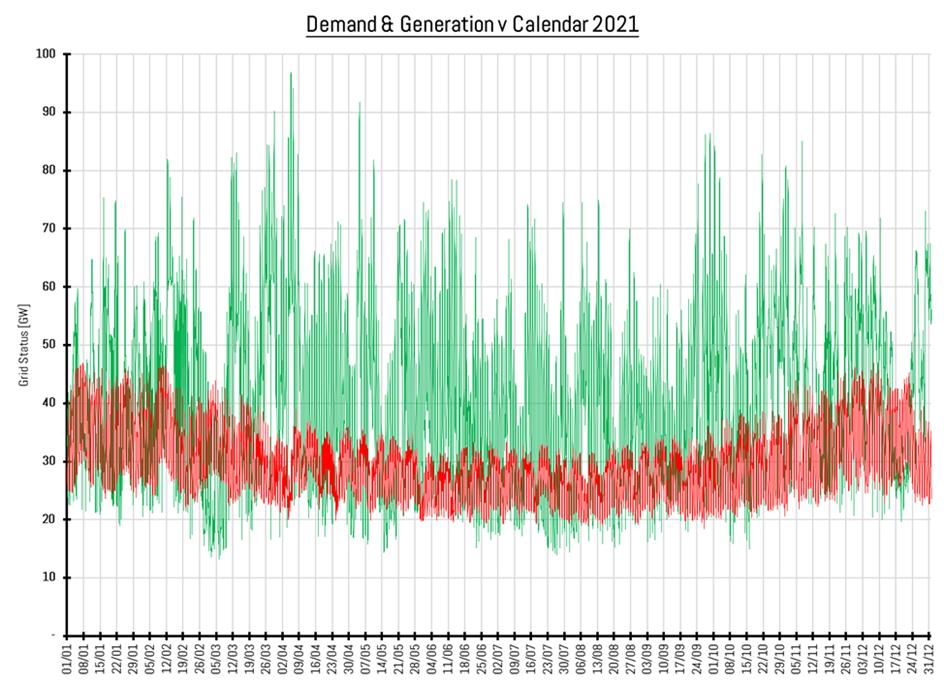
As we anticipated that the expected generation will be in the region of 365TWh per year versus a demand of 260TWh per year, it is not a surprise to see that the green generation line is consistently above the red demand line. The graph, or Exhibit 2, also demonstrates occasions when mean generation falls below mean demand, resulting in periods when generation cannot meet demand. This means the National Grid is forced to source energy from elsewhere.
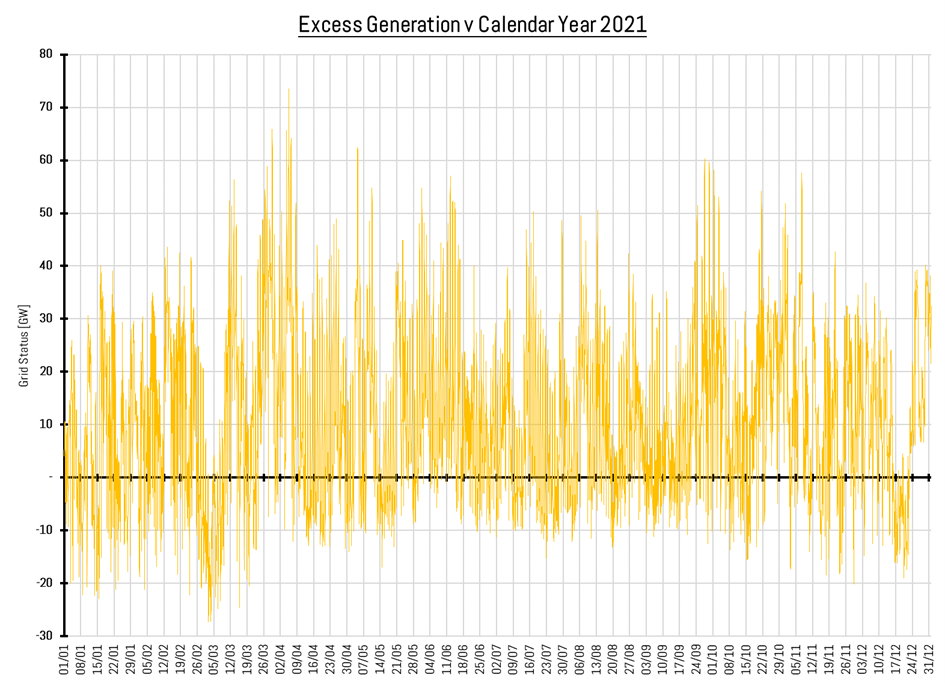
To make it easier to determine the mean daily balance, Exhibit 3 is plotted based on subtracting the demand value from the generation value to calculate the amount of ‘generation excess’. Anything below the black line is a risk of blackout.
Exhibit 3: Graph demonstrating the amount of ‘generation excess’
While fossil fuels can be stored almost indefinitely with the chemical energy effectively being able to be converted to electricity on demand, this flexibility is not available with solar PV and wind. As we move away from relying on fossil fuels to a 100% clean electricity grid, this misalignment challenge needs to be tackled.
Without action to resolve this issue, there will be insufficient generation to cover demand 24% of the time, covering 13TWh of total demand (4.9%), based on 2021 UK demand patterns. What this means in practical, every-day terms, is that for approximately 2100 hours a year, there would be insufficient generation capacity with a 100% net zero grid. To keep the ‘lights on’ an operator intervention would be required, for example using fossil-fuel generation assets, curtailing high demand users, or pulling power through interconnectors if excess capacity is available. Some users, businesses, and consumers would suffer blackouts through a simple lack of power availability.
While one side of the conundrum is that generation won’t always meet demand, the other side means that there will be increased periods of time when there is too much generation for the amount of demand, requiring net-zero generation curtailment. In this case, 76% of the time there is excess generation totalling 118TWh, meaning that 32.4% of the total generation is being curtailed, rather than used or stored. This represents a significant waste of green energy and is a costly issue for the National Grid ESO who may be forced to pay for the excess generation, whether it is used or not.
Households and businesses are paying for this via their energy bills, and with the skyrocketing price caps, unless solved, this problem will have a detrimental impact on everyone, particularly those faced with fuel poverty.
There must be a way to balance this without impacting people on a day-to-day basis?
To balance both sides of this equation, there is an obvious solution here: electricity storage, with the ability to act as a safeguard when demand drastically increases, or when excess electricity is generated. Charge it up when the sun is shining, and the wind is blowing, and discharge it when they aren’t. It really is as simple as that.
The fundamental theory here is not new as most people will be familiar with hot water tanks which hold hot water for instant use on demand and then heat up water when not in use for the next time it is needed. While the market is still in relative infancy at utility scale for electricity, it is growing all the time.
Can we predict the amount of Electricity Storage that we need?
Taking our analysis of 2021, this indicates that to reduce the time when there is an excess of demand down from 24% to 10%, 5%, 2% and 1%, then electricity storage in the region of 125GWh, 250GWh, 600GWh and 1,400GWh will be needed respectively. These are large numbers that are orders of magnitude bigger than what is currently in development with current market drivers (<50GWh). But this is assuming that the Energy Security Strategy and the 2021 UK demand is a rock-solid guarantee that the Government will deliver what is needed.
We have estimated the electricity storage requirement is in the range of 100GWh – 1,500GWh depending on how infrequently the National Grid ESO must make decisions to align demand and net-zero compliant generation. At the bottom end of this range, the National Grid ESO will need to make decisions during 10% (equivalent to nearly 2.5 hours a day) of the time annually. Whereas at the top of this range, they will only need to intervene during 1% (approximately 15 minutes a day) of the time annually. We want to be at the top of this range.
What happens if the Government can’t meet their targets and demand increases?
Up to this point, our analysis has assumed that the UK Government can deliver on their promises and energy capacity, and assumes that demand would not increase over time, which is unlikely. Whilst we should welcome the Government’s ambitious targets, there are some longstanding delivery challenges that won’t go away just by simply publishing the Energy Security Strategy.
Coupled with the inevitable increase in electricity demand, primarily driven by the electrification of transport and heating, these two assumptions need to be challenged and sensitivities considered if we want to reach a robust target that, if delivered, will really provide the performance expected of it.
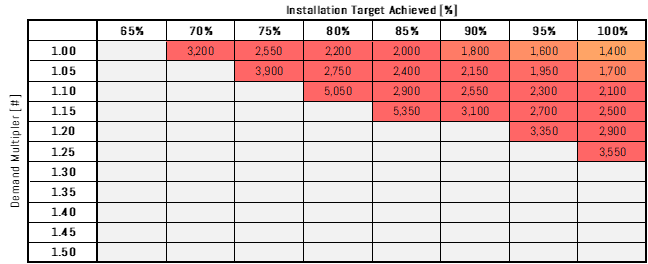
Exhibit 4 and Exhibit 5 look at the potential amount of electricity storage needed based on two key variables. The first variable is the percentage of installation achieved versus the target, and secondly how the demand will change versus the 2021 demand. Grey boxes indicate that storage greater than was analysed (5,760GWh – 60GW @ 96h) would be needed, which would be unrealistic to implement. These two tables demonstrate the implications of a 20% excess energy demand, and a 1% excess energy demand.
Exhibit 4: 20% Excess Demand v Generation Position
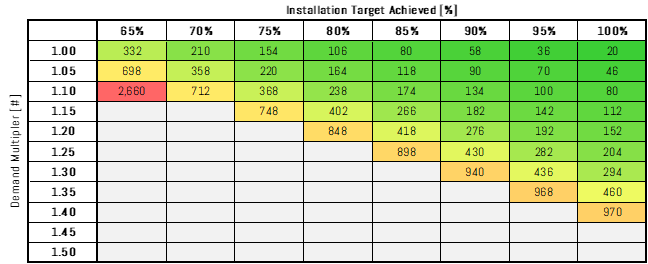
Exhibit 5: 1% Excess Demand v Generation Position
What are the key takeaways from these tables?
It’s not a surprise that with an increase in demand, more energy storage is needed. What is unexpected, is that rapid increase in electricity storage needed to maintain the status quo from the original position. A pattern emerges in that if you wanted to half the number of periods that the National Grid ESO was required to intervene, then you would need to double the amount of electricity storage.
As you start to look at the sensitivity position, you can see it’s not a linear relationship whereby as demand increases by 10%, installation increases by 10%. Instead, the storage requirement almost doubles and the growth continues exponentially onwards. The increase in electricity storage requirement is not as extreme due to underachievement of the installation target, but at <80% achievement (the left half of the tables) the required electricity storage really starts to grow.
At this point other solutions, either introducing even more ambitious stretch generation targets or introducing market reforms such as allowing sophisticated half-hourly power pricing all the way down to the domestic level will need to take the lead.
What this analysis is telling us is that it is critical for the Government to aggressively pursue and achieve its ambitious targets if they want the net-zero grid target to be realised. There is virtually no leeway available within the targets set out, everything needs to work.
What does the current UK electricity storage market look like?
At the moment, the electricity storage market is being driven by shorter duration solutions in the region of 1h to 2h, but this is not sustainable if we want to reach net zero. Longer storage solutions are currently in their infancy, and it is likely that 4h solutions will become the default, but not until the late 2020s. While, theoretically it is possible to retrofit additional hourly capacity onto any existing electricity storage project, this will not be exploitable on most current schemes due to lack of space and other site restrictions. Additionally, the commercial proposition dampens with decreasing marginal profit available with each subsequent hour added to the electricity storage system.
If we very optimistically determined that it would be acceptable for the National Grid ESO to intervene 5% of the time, if all the generation capacity was built and that UK demand would not grow, then our analysis indicates that approximately 250GWh of storage would be required.
If current project philosophies of 2h persist, this would indicate that 125GW of connected battery capacity would be needed, this is unlikely to be feasible due to the currently constrained grid network for existing applications. The only other way to meet this goal of 250GWh would be to increase the hourly capacity of each connection; this would likely mean that each connection would need upwards of 10h of capacity which is not where the market is currently heading in the short-to-medium term.
What needs to be done?
Left unabated, the electricity storage market is not going in the right direction to invest in the infrastructure that is needed to reach net zero. More attention needs to be paid to electricity storage, along with increased investment in advancing technology, if we are to reach and sustain a net zero grid.
What we need is more attention directed at developing electricity storage technology, particularly longer duration storage, and a streamlined planning process to enable a swift roll out of the electricity storage projects that the UK requires. We’re not going to reach net zero if we can’t solve the issues around excess.
The question that should be on the Government’s mind is not “do we need electricity storage?” but, “how much electricity storage do we need?”