

Foreword
Recently, there has been a renewed focus on the zero-carbon credentials of batteries. Coupled with the fact that the batteries themselves do not actually generate any electricity from another form of energy, for example, sunlight or wind, people are asking how we can classify batteries as a zero-carbon or renewable technology.
Here I analyse and share quantitative outcomes of how a battery scheme can deliver reduced carbon emissions and show how they are a necessity in the transition to a net zero grid.
To note, this piece contains technical analysis suited to an industry / professional audience and those working within the energy sector.
Nick Provost, Commercial Manager at Balance Power Projects
How closely are economic and environmental outcomes linked?
Traditionally, centralised fossil fuelled power stations could ramp their outputs up and down, in response to varied demand. If prices were too low due to lack of demand, you could choose to ramp down generation and save your fuel for when prices are higher, the opposite is true if prices are too high. What is different about solar PV and wind, is that you can’t simply ramp up to meet demand and you can’t save fuel for when prices are higher. The generation happens when it happens as it is an uncontrolled input. As a result, battery storage has become more important.
To fully understand how a battery can be zero-carbon, we need to know how a battery will operate and how it derives revenue to provide a feasible, viable, and deliverable project. Ensuring viability of batteries and minimising the operational carbon footprint are very closely aligned – it is not an ‘either-or’ situation.
What links the economic and environmental case for batteries are the reasons behind how wholesale electricity prices are driven and feed price signals which the asset control system will respond to. To ensure viability of the battery, it will be charged when electricity can be purchased from the grid at its cheapest and discharged when the electricity can be sold at the highest price to the grid. Prices will be lower when there is an oversupply of generation versus power demand and prices will be higher when there is a deficit of generation versus the prevailing demand. This is a simple case of supply and demand dynamics.
The economics behind supply and demand make sense, but how does this link to environmental benefit?
To understand what the environmental impact of a battery will be, we need to look at the carbon intensity of the electricity that would have otherwise been curtailed or would need to be generated if the battery wasn’t present. This may not be the same as the actual real-time carbon intensity of the electricity. This is explained in more detail below.
Charging the battery with zero-carbon electricity
If there is a very windy night, there could be an abundance of wind powered generation, but this could coincide with the lowest grid demand, meaning there is a huge excess in generation. This will drive very low wholesale pricing as supply could massively outstrip demand and in extreme situations, the wholesale price will ‘go negative’ (which effectively results in paying consumers to consume electricity) to help balance the system and keep the grid frequency within acceptable operational tolerances.
If you still can’t find enough additional demand to absorb the excess power, then the grid will be forced to curtail some generation and will make payments to operators to effectively turn off their assets. These payments costed the National Grid ESO around £1,192m in 2021[1] and this is forecast to get much higher as more renewable generation technology is installed and commissioned in line with the UK Government’s Energy Security Strategy.
A battery system in this scenario will be able to store some of this excess generation that has come from the over producing windfarm, both at a low price but also be zero-carbon. Whilst it would be difficult to categorically prove that all the electricity charging the battery will be zero-carbon, it intuitively makes sense that the battery system will exploit any depression in the wholesale price that will likely be linked to excessive renewable generation.
Discharging the battery by displacing high carbon electricity
At the other end of the spectrum, during periods of high demand it is currently very unlikely that existing renewable generation would be able to deliver all the necessary power to cover this. This will inevitably mean that dispatchable fossil-fuelled power would be required to pick up the slack.
Currently in the UK, combined-cycle gas turbines (CCGTs) are the preferred choice to deliver the balance between demand and current zero-carbon generation, and it delivers this electricity at a mean of 0.394tCO₂/MWh-e[2]. Whilst this is the preferred choice, this category of generation is finite and if there is not enough zero-carbon generation or a very high demand, then more carbon-intensive forms of electricity generation will be called upon to meet demand. These are predominantly open-cycle gas turbines (OCGTs) and coal which have carbon intensities of 0.651tCO₂/MWh-e[2] and 0.937tCO₂/MWh-e[2] respectively.
The wholesale electricity price will be at its highest when there is the biggest difference between demand and generation. What a battery can do by exporting power during periods of peak demand, when prices are highest, is prevent electricity being sourced from high carbon intensity power sources instead. Therefore, a suitably large array of batteries would be able to limit or even eliminate the deployment of coal generation which will deliver a huge carbon abatement.
Differential in carbon intensity between charging and discharging
Based on the assertions made in the previous two sections, it is always likely that the carbon intensity of the electricity that the battery will displace during the discharging phase will be greater than the carbon intensity of the electricity that the battery will consume during the charging phase. This will still be true when you consider the end-to-end efficiency of the battery system which is in the region of 87-88%.
How do the numbers stack up?
To prevent confusion between storage capacity and electricity volume which are both measured in megawatt-hour (MWh) or equivalent multiple; we will use additional subscripting to provide clarification. MWh-c will refer to the installed capacity of a battery system whilst MWh-e will refer to a quantity of electrical energy. Also, where possible we reference CO₂e which refers to the equivalent total CO₂ impact of all released greenhouse gases, rather just CO₂ alone.
The exact carbon abatement that a battery system will be able to deliver depends on the prevailing conditions of the system – more specifically the types of generation that are operational at any given time. If we were to take the most extreme example of i) zero-carbon charging, ii) coal generation discharging displacement, iii) a typical battery scheme capacity of 100MWh-c and iv) a discharging efficiency of 93.5%; this would give a carbon abatement of 87.6 tonnes for a single complete charging and discharging cycle. This is the equivalent of displacing ≈319,000 miles of car usage based on a typical UK car emission of 170.7gCO₂e/km[3]. This should be seen as the upper limit for what a battery can achieve during a single complete cycle.
This is an extreme example, so cannot be reasonably extrapolated for every cycle. To do this, we need to determine a more suitable set of assumptions to provide lifetime carbon abatement figures. There is also a locational element to this as there are limits to how much power can be transmitted across the grid between assets due to the capacity of the physical infrastructure.
For 2022, the UK carbon intensity for electricity generation is 0.19338tCO₂e/MWh-e as a generic catch-all number[3]. If we took an assumption that this is representative of the electricity that is charging the battery and we took a conservative case that whilst discharging the battery was only displacing CCGT generated electricity at 0.394tCO₂e/MWh-e then we would get a carbon abatement of 16.18tCO₂e for a 100MWh-c system during a single cycle. The calculation steps are below (no intermediate rounding applied):
100MWh-c / √87.5% = 106.9MWh-e (106.9MWh-e required to charge the 100MWh-c battery)
106.9MWh-e * 0.19338tCO₂e/MWh-e = 20.67tCO₂e released during charging phase
100MWh-c * √87.5% = 93.5MWh-e (93.5MWh-e will be discharged from the 100MWh-c battery)
93.5MWh-e * 0.394tCO₂e/MWh-e = 36.86tCO₂e abated during discharging phase
36.86tCO₂e – 20.67tCO₂e = 16.18tCO₂e per complete cycle.
If we extrapolate this out over the complete battery operation of up to 20 years[4], then we get an operational carbon abatement of around 138,920tCO₂e. The calculation steps are again below:
16.18tCO₂e/cycle * 1.5 cycles/day * 365 days/year * 98% availability[5] = 8,683tCO₂e/yr
8,683tCO₂e/yr * 20 years * 80% capacity[6] = 138,920tCO₂e
Relating this back to car mileage for comparison, this is the equivalent of ≈500,000,000 miles or removal of ≈2,500 cars off the road for 20 years (based on an annual mileage of 10,000 miles).
138,920,381kgCO₂e / 0.17067kgCO₂e/km / 1.609km/mile= 505,886,085mile
505,886,085mile / 10,000mile/car/yr / 20yr = 2,529 cars
Sensitivities for a comparison
To note, if you would like to calculate the outcomes based on your own inputs, please see the Appendix at the end of this piece for further information.
The difference between the carbon intensity of the electricity consumed to charge the battery and the electricity that the battery is displacing during discharge makes a significant difference to the overall carbon abatement figure. Below, Exhibit 1 and Exhibit 2 show the carbon abatement values based on various differentials.
Since there is a round trip efficiency that needs to be considered, the absolute values of the charging and discharging carbon intensities do have a minor impact. Therefore, the sensitivity table below is built with two variables in mind. Down the side is the differential between the discharging and charging carbon intensities in relative terms and along the top is the absolute value of the charging carbon intensity. Both sets of values are in tCO₂e/MWh-e.
Exhibit 1: Equipment lifetime carbon abatement (operational phase only)
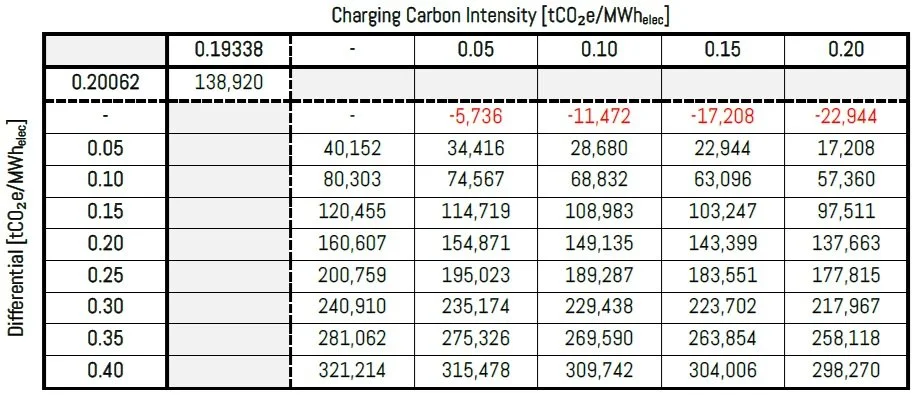
Exhibit 2: Equipment lifetime car removal equivalent (operational phase only)
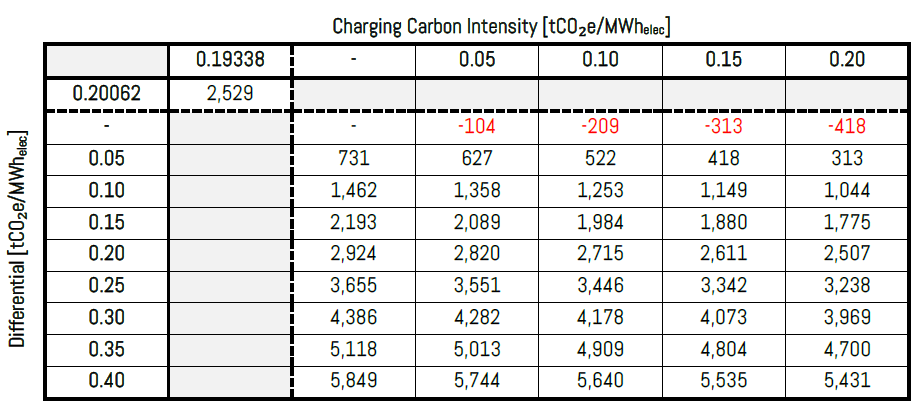
The only scenarios under which the battery system comes out as a net negative CO₂ position will be if the differential between the discharging and the charging carbon intensities is very small (<0.025tCO₂e/MWh-e). My view is that, due to the peaks and troughs of daily demand and the ongoing and increasing volatility of renewable generation, there will often be occasions within each day where there will be a positive difference in favour of the battery.
The operation provides a positive carbon position. Is it bigger than the embedded carbon?
Given that battery systems are being sold based on their net zero credentials, it is reasonable to ask what the carbon impact of the system is outside of the operation of the equipment. The theory being that if the embedded carbon released during the construction is greater than the operational carbon saving; from an environmental perspective it would be better to leave the minerals in the ground in the first place.
A study by the IVL Swedish Environmental Research Institute in 2019 indicates that the sum of the material upstream, cell production, and pack assembly is in the region of 59 – 119kgCO₂e/kWh-c battery capacity [7]. The reason for the wide discrepancy is due to the varying carbon intensity of the electricity used in the cell production which ranged from 0 – 60kgCO₂e/kWh-c depending on whether fully renewable sources or dirtier fossil fuels are used.
The summary of the same report indicates that in Europe, the Product Environmental Footprint (PEF) benchmark represents 12% of the total greenhouse gas emissions for batteries in the end-of-life stage. If we took the midpoint of the manufacturing figures in the paragraph above of 89kgCO₂e/kWh-c, this would give a figure of ≈100kgCO₂e/kWh-c.
Over time we would expect this figure to go down with improvements in battery chemistry, a wider prevalence of renewable electricity within battery manufacturing, and improved recycling of key materials. Even today, three years after this report was published, the calculated number of 100kgCO₂e/kWh-c above may have been improved upon. A 2017 estimate was in the region of 150 – 200kgCO₂e/kWh-c which reinforces this point.
Further working in the favour of utility scale battery schemes is the economies of scale that could be deployed since this report has calculated the carbon based on EV batteries with a capacity in the order of 10 – 50kWh-c, many multiples lower than the utility scale batteries with capacities of ≥50,000kWh-c. The theory being that any fixed environmental impact can be spread over a larger capacity that will give a lower unit impact number.
The only carbon that is missing from these calculations is the carbon released during construction of the actual battery scheme itself that would cover items such as the copper extraction, steel manufacture, and diesel consumption during transport. No reliable estimate has been found that can be used in this analysis. Therefore, this has been omitted.
Returning to the 100MWh-c figure that I have used for the operational examples above, this calculates to an embedded carbon figure of 10,000tCO₂e. Taking our default position providing an operational saving of 138,920tCO₂e; this is an equipment lifetime saving of 128,920tCO₂e. This provides an effective carbon ‘return on investment’ of ≈1,300% over a 20-year equipment life.
Please see Exhibit 3 below as an extension of the Exhibit 1 table above to include the manufacturing carbon released.
Exhibit 3: Equipment lifetime carbon abatement (excluding project construction carbon release)
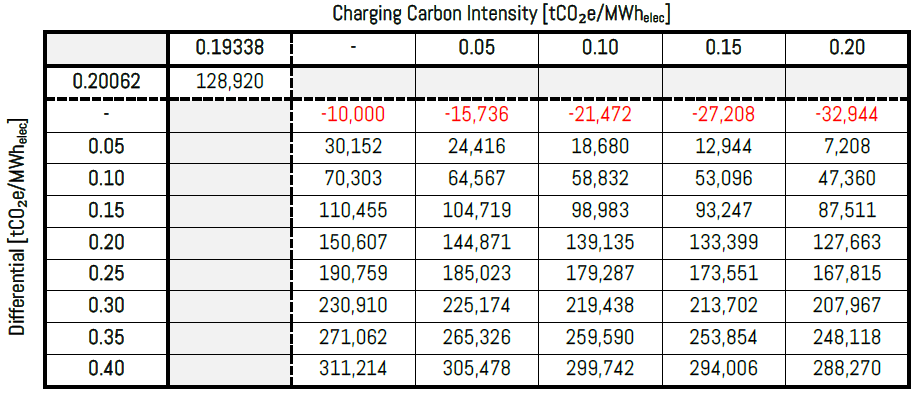
Adding the embedded carbon into the mix, it makes only a small difference to the overall conclusion determined in the previous section. Rather than the smallest required differential being 0.025tCO₂e/MWh-e, this increases to 0.040tCO₂e/MWh-e which based on expected volatility would be easily achievable.
Summary and conclusion
Some conclusions have been outlined in this piece, for reference, below I have summarised the key takeaways.
Firstly, the key to understanding what the environmental impact will look like for a battery is to look at the carbon intensity of the electricity that would have otherwise been curtailed (during the charging phase), and would need to be generated if the battery wasn’t present (during the discharging phase).
Secondly, what a battery can do by exporting power during periods of peak demand, when prices are highest, is prevent electricity being sourced from high carbon intensity power sources instead. Therefore, a suitably large array of batteries would be able to limit or even eliminate the deployment of coal generation which will be a huge carbon abatement.
Finally, it is always likely that the carbon intensity of the electricity that the battery will displace during the discharging phase will be greater than the carbon intensity of the electricity that the battery will consume during the charging phase.
All of these three key points underpin the net-zero credentials of battery storage technology.
This analysis was conducted and is written by Nick Provost, Commercial Manager at Balance Power Projects. Nick has an engineering background with a Mechanical Engineering degree from the University of Manchester and is a Chartered Engineer with the IMechE.
Appendix
All figures in this analysis are based on a 100MWh-c utility scale battery system as this is reflective of the typical scale of battery projects in the UK in 2022. However, not all projects are uniform and come in different shapes and sizes; for that reason, the metrics that we have calculated for the 100MWh-c projects are provided on a MWh-c basis.
If you know the capacity of the proposed system you are working with, you can simply multiply that by the final numbers in bold below. The assumptions used are the same as used in the earlier section but are listed here for completeness and ease. If you wish to use alternative figures then you will need to follow the calculation methodologies laid out in the numbered bullets within previous sections.
Charging electricity carbon intensity = 0.19338tCO₂e/MWh-e
Discharging electricity carbon intensity = 0.394tCO₂e/MWh-e
Round trip efficiency = 87.5%
Operational cycles per day = 1.5
System availability = 98%
Equipment lifetime = 20 years
Mean battery capacity versus installed capacity = 80%
Car emissions = 170.7gCO₂e/km
Annual car mileage = 10,000mile
Carbon abatement per complete cycle = 0.1618tCO₂e/MWh-c/cycle
Equipment lifetime carbon abatement (operational phase only) = 1,389tCO₂e/MWh-c
Equipment lifetime car removal equivalent (operational phase only) = 25.3 cars/MWh-c
Embedded carbon (excluding project construction) = 100tCO₂e/MWh-c
Equipment lifetime carbon abatement (excluding project construction) = 1,289tCO₂e/MWh-c
[1] Figure compiled by Aurora Energy Research from data provided by National Grid ESO covering thermal, voltage and stability constraints
[2] National Grid ESO Carbon Intensity Forecast Methodology – January 2021
[3] UK Government GHG Conversion Factors for Company Reporting Excel file
[4] 20 years has been used as that is the useful life of the equipment. A complete project could last up to 40 years, but this would require further procurement
[5] Availability factor to allow for maintenance and other equipment outages
[6] A lithium-ion battery will degrade over the life of the asset to around 60% of its original capacity by year 20 based on a 1.5 cycles per day operational profile. The 80% figure allows for this adjustment
[7] Lithium-Ion Vehicle Battery Production (ivl.se)